
Spitfire Boat Trailers
Choosing a boat trailer isn’t just about length and weight capacity. The shape of your boat’s hull determines how it should sit on the trailer, which support systems work best, and ultimately whether your vessel stays protected during transport. A mismatch between hull type and trailer configuration leads to stress points on the hull, poor weight distribution, and potential damage over time.
Australian waters see everything from aluminium tinnies with flat bottoms to offshore fishing boats with deep-V hulls. Each design interacts differently with trailer bunks, rollers, and support systems. Understanding these differences helps you select a trailer that cradles your boat securely rather than fighting against its natural shape.
This guide breaks down the major hull types found in Australian boating and explains exactly what trailer features each one requires. Whether you’re running a pontoon on inland waters or towing a deep-V offshore rig, you’ll learn how to match your hull to the right support system.
This article covers the five most common hull types in Australian recreational boating: flat bottom, modified-V, deep-V, pontoon, and catamaran. For each hull type, you’ll learn about the hull’s characteristics, ideal trailer support configuration, and key considerations for safe transport. The guide also addresses weight distribution principles, the role of adjustable components, and how to verify proper fit before hitting the road.
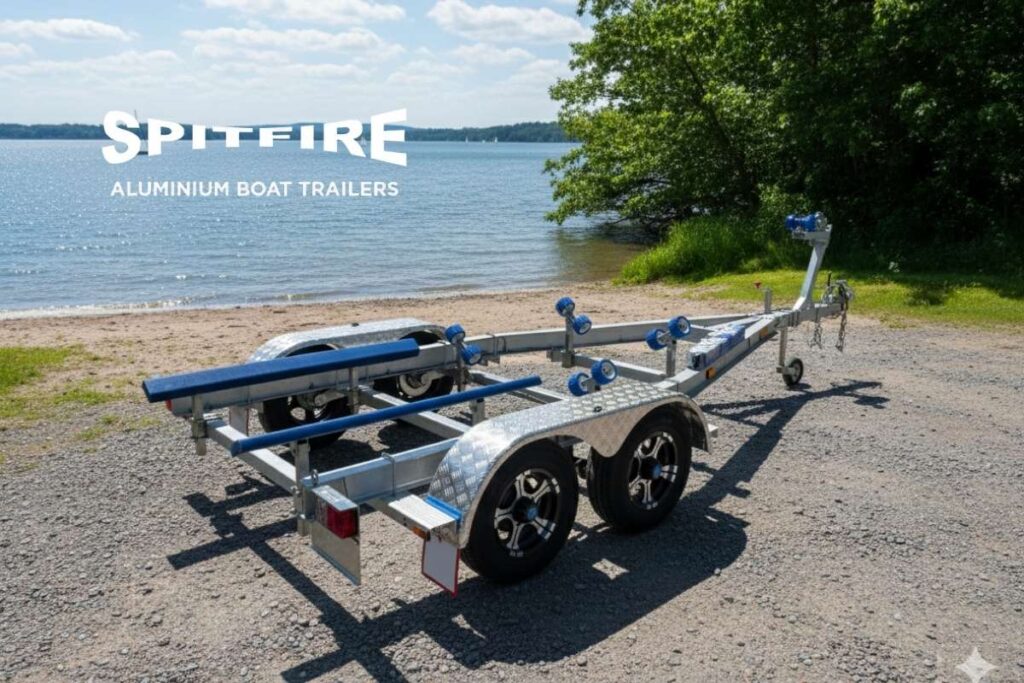
Every boat hull is engineered to perform specific functions on the water. A deep-V cuts through chop while a flat bottom provides stability in calm conditions. These same design characteristics affect how the hull bears weight when sitting on a trailer.
When a boat rests on its trailer, the hull’s weight transfers through the points of contact with bunks or rollers. If these contact points don’t align with the hull’s shape, weight concentrates in small areas rather than distributing evenly. Over time, this causes gelcoat cracking on fibreglass boats and structural fatigue on aluminium hulls.
The angle of the hull’s deadrise (the V-shape measured from the keel to the chine) directly determines what bunk angle or roller configuration works best. A flat bottom boat has zero deadrise and sits naturally on flat bunks. A deep-V offshore hull with 20+ degrees of deadrise needs angled supports that match its steep sides.
Understanding your hull’s specific characteristics allows you to select trailer components that work with your boat’s design rather than against it. This knowledge proves especially valuable when choosing the right boat trailer size for your vessel.
Flat bottom boats feature minimal or zero deadrise across the hull’s width. Common examples include small aluminium tinnies, jon boats, and some punt-style vessels. These hulls offer maximum stability in calm water and typically range from 3 to 5 metres in length.
The flat running surface means weight distributes evenly across the hull’s bottom when the boat sits on a trailer. This even distribution makes flat bottom boats relatively forgiving when it comes to trailer setup.
Flat bottom hulls work excellently with standard flat bunk trailers. The bunks should run parallel to the keel and make contact along as much of the hull’s length as possible. HDPE (high-density polyethylene) bunk covers protect the hull surface and allow the boat to slide smoothly during launching.
Roller trailers also suit flat bottom boats, particularly for solo operators who need easy loading. A combination of keel rollers and wobble rollers provides multiple contact points without requiring precise alignment.
For small tinnies and flat bottom boats, boat trailers designed for small boats typically come pre-configured with appropriate bunk spacing and angles.
Modified-V hulls represent the most common design in Australian recreational boating. These hulls feature a sharper V-shape at the bow that gradually flattens toward the stern, typically showing 10 to 15 degrees of deadrise at the transom. This design balances rough water capability with stability at rest.
The variable deadrise angle means the hull’s shape changes from bow to stern. Trailer support systems must account for this transition rather than treating the hull as uniform along its length.
Modified-V hulls benefit from bunks set at a slight angle to match the hull’s deadrise at the stern. The bow section, with its sharper entry, often requires keel support through a keel roller or padded keel guide.
Many Australian boat owners find that understanding vee guides and rollers helps them achieve proper bow centring and keel support for modified-V hulls. These guide systems work particularly well for self-loading during retrieval.
The roller vs bunk decision often comes down to launching conditions. Bunks provide superior hull support during transport, while rollers offer easier loading at shallow ramps.

Deep-V hulls feature steep deadrise angles of 18 to 24 degrees maintained from bow to stern. This design dominates offshore fishing boats and performance vessels built for rough water. The sharp entry and consistent V-shape slice through waves but create specific trailer requirements.
Deep-V boats typically range from 5.5 to 8.5 metres and carry significant weight in engines, fuel, and fishing equipment. The combination of hull shape and total weight makes proper trailer support critical.
Deep-V hulls require bunks angled steeply to match the hull’s deadrise. Standard flat bunks force the keel to bear excessive weight, creating stress points. Properly angled bunks distribute weight across the hull’s panels rather than concentrating it along the centreline.
Keel rollers become essential for deep-V boats. These rollers support the keel directly and help centre the boat during loading. Combined with angled side bunks, a keel roller system provides the three-point support deep-V hulls need.
For larger deep-V offshore boats, trailer capacity and axle configuration matter as much as bunk setup. Choosing the best boat trailer for offshore fishing boats covers these considerations in detail.
Owners of heavy deep-V boats should also consider whether their setup requires single or dual axle configuration for proper weight distribution and braking performance.
Pontoon boats use cylindrical aluminium tubes (pontoons) as their flotation and hull structure. These tubes sit parallel to each other beneath a flat deck platform. Pontoon boats range from small two-tube recreational models to large tri-toon vessels with three pontoons.
The cylindrical shape of pontoons means they have no flat surface to rest on. Standard boat trailer configurations designed for conventional hulls don’t work for pontoon boats.
Pontoon trailers use separate bunk systems positioned to cradle each pontoon tube. The bunks typically feature curved or V-shaped profiles that wrap partially around the tubes, preventing lateral movement.
Cross-member spacing must align with the pontoon tube positions. Adjustability in bunk width allows the trailer to accommodate different pontoon spacing between manufacturers.
The trailer frame sits lower than conventional boat trailers to keep the deck height manageable during towing. This low-profile design also helps with stability given the pontoon boat’s higher centre of gravity.
Catamarans feature two separate hulls connected by a deck structure. Each hull typically shows a fine entry for cutting through waves. The space between hulls varies by design, affecting trailer requirements significantly.
Multi-hull vessels range from small sailing catamarans to powered fishing cats. The dual-hull design creates excellent stability on water but requires specialised trailer support.
Like pontoon boats, catamarans need separate support systems for each hull. Bunks position under each hull at the appropriate angle to match the individual hull’s shape (often a moderate V-shape).
The trailer frame must span the full width of the catamaran while providing structural support between the hull positions. Some catamaran trailers use adjustable bunk carriers that slide along cross-members to accommodate different hull spacing.
Loading a catamaran requires precise alignment to ensure both hulls contact their respective bunks simultaneously. Guide systems and bow stops help achieve consistent positioning.
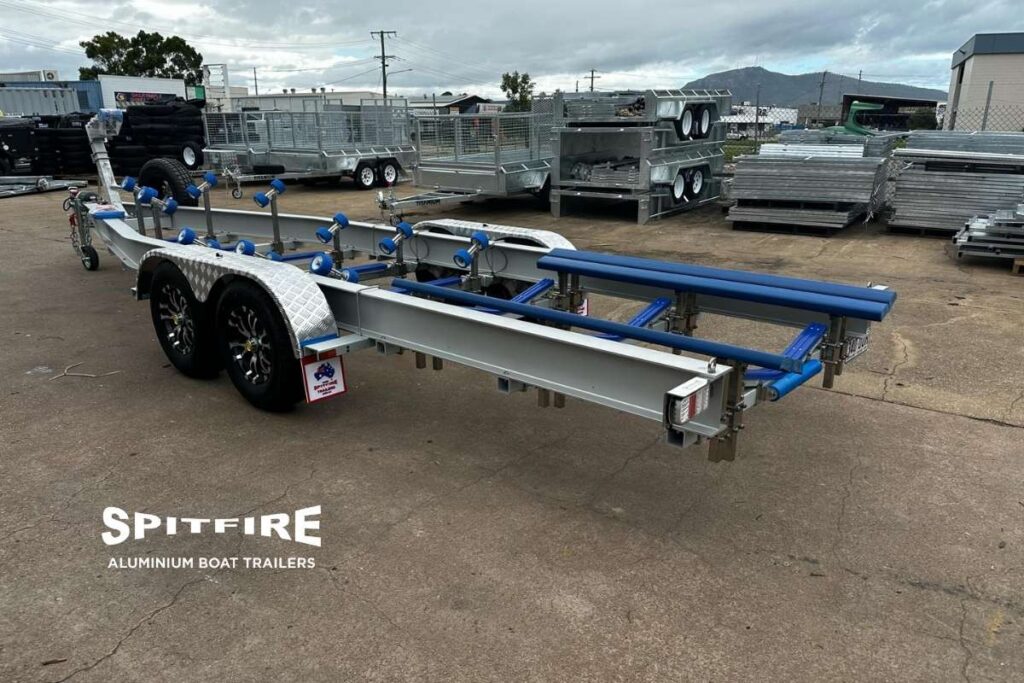
Quality boat trailers include adjustable bunks, rollers, and guide systems. These components allow fine-tuning to achieve optimal hull contact. However, adjustability has limits, it cannot transform a trailer designed for flat bottoms into one suitable for deep-V hulls.
When selecting a trailer, start with the correct base configuration for your hull type. Use adjustability to perfect the fit rather than compensate for fundamental mismatches.
Spitfire trailers feature standard VeeGuide bunks and HDPE keel slides that accommodate various hull shapes within their design parameters. These premium features provide adjustment range while maintaining proper support geometry.
After loading your boat, perform these checks:
These checks should be repeated after any bunk adjustments and periodically throughout the ownership period. Learn more about pre-trip verification in the guide to essential safety checks before towing.
Can I use a flat bunk trailer for a deep-V hull boat? No. Flat bunks force deep-V hulls to rest on their keel, concentrating weight along the centreline and causing potential hull damage. Deep-V boats require angled bunks matching their deadrise angle plus keel roller support.
What deadrise angle determines whether I need angled bunks? Hulls with deadrise angles above 15 degrees generally require angled bunks. Below 15 degrees, flat or slightly angled bunks typically provide adequate support. Check your boat’s specifications or measure the angle at the transom.
Are roller trailers better than bunk trailers for certain hull types? Rollers suit modified-V hulls well and make solo loading easier. Deep-V hulls benefit from combination systems using both keel rollers and angled bunks. Flat bottom boats work well with either system.
How do I know if my boat’s weight is distributed correctly on the trailer? Measure tongue weight with the boat loaded as it would be for travel (including fuel and gear). Tongue weight should be 7–10% of total trailer weight. Too little causes trailer sway; too much overloads the tow vehicle’s rear.
Can I modify my existing trailer to suit a different hull type? Minor modifications like adjusting bunk angles are feasible. Major changes—like converting a conventional trailer to a pontoon trailer—typically cost more than purchasing the correct trailer type.
What causes hull damage from improper trailer fit? Concentrated pressure points create stress cracks in fibreglass gelcoat and fatigue cracking in aluminium. Over time, these pressure points can cause structural weakening, water intrusion, and expensive repairs.
Do aluminium boats have different trailer requirements than fibreglass boats? Hull shape matters more than hull material for trailer selection. However, aluminium boats often feature sharper hull angles and handle point loading slightly better than fibreglass. Both materials benefit from proper weight distribution.
How often should I check bunk and roller alignment? Inspect alignment before each trip and perform a thorough check at the start of each boating season. Bunks compress over time and rollers wear, potentially changing the support geometry.
What’s the best trailer configuration for a boat I use in saltwater? For saltwater use, the trailer material matters as much as the configuration. Anodised aluminium trailers resist corrosion far better than galvanised steel while providing all standard configuration options for different hull types.
Where can I get help determining the right trailer for my specific boat? Spitfire Trailers offers expert guidance through their contact page or at showrooms in Townsville, Rockhampton, and Brisbane. Bring your boat’s specifications including length, beam, weight, and hull type for personalised recommendations.
Matching your hull type to the right trailer protects your investment and ensures safe towing across Australian roads. Spitfire Trailers designs and manufactures anodised aluminium trailers in Queensland with adjustable VeeGuide bunks and HDPE keel slides suited to various hull configurations.
Use Spitfire’s Boat Sizing Guide to find the trailer that matches your boat’s length, weight, and hull type—or request a quote for personalised recommendations from the expert team.
|
Uploaded
Failed
|
 |