
Spitfire Boat Trailers
The choice between Vee guides and rollers on your boat trailer can significantly impact your launching experience, boat protection, and long-term maintenance requirements. As Australia’s leading manufacturer of premium aluminium boat trailers, Spitfire Trailers QLD understands that the right support system makes all the difference between a smooth day on the water and a frustrating struggle at the boat ramp.
Whether you’re launching a 4.6-metre tinny in shallow Queensland waters or maneuvering a 8.5-metre yacht at a busy marina, your trailer’s guide and roller configuration directly affects how easily your boat launches, how well it’s protected during transport, and how confidently you can retrieve it after a day’s fishing or cruising. With over two decades of Australian marine engineering excellence, Spitfire has refined both Vee guide and roller systems to deliver superior performance across our complete range of aluminium boat trailers.
This comprehensive guide examines the critical differences between Vee guides and roller systems on boat trailers, helping Australian boat owners make informed decisions about their trailer configuration. You’ll discover how each system works, their respective advantages and limitations, and why Spitfire’s engineering approach delivers superior results regardless of which option you choose.
We’ll explore real-world applications across different boat types and sizes, maintenance requirements for both systems, and the specific conditions where each excels. Additionally, you’ll learn about Spitfire’s innovative VeeGuide bunk technology, our flexible roller options, and how our Australian-designed systems handle the unique challenges of saltwater environments, shallow launches, and varied tidal conditions.
Vee guides represent the evolution of traditional boat trailer support systems, incorporating precisely angled channels that cradle your boat’s hull during transport and provide exceptional guidance during launching and retrieval operations. Unlike flat bunks or simple roller configurations, Vee guides create a secure, stable platform that naturally centers your boat while protecting the hull from damage during the loading process.
Spitfire’s proprietary VeeGuide bunk system takes this concept further, utilizing specially engineered angles and high-quality materials to create the optimal balance between support and smooth operation. These guides extend along the trailer’s length, providing continuous hull contact that distributes weight evenly and prevents stress concentration points that could damage your boat’s structure over time.
The engineering behind effective Vee guides involves careful calculation of angles, materials selection, and positioning to match specific boat hull profiles. Spitfire’s VeeGuide bunks incorporate marine-grade carpeting and precision-cut channels that accommodate the natural V-shape of most Australian boat hulls, from shallow-draft tinnies to deep-V offshore vessels. This attention to detail ensures consistent performance across our entire range, from our 4.6-5.1m trailers to our heavy-duty 4500kg ATM models.
The operational mechanics of Vee guides center on their ability to provide controlled guidance while maintaining minimal friction with the boat hull. As you reverse your trailer into the water, the Vee-shaped channels naturally guide your boat into perfect alignment, preventing the sideways drift that can occur with roller systems in crosswinds or current.
During retrieval, the guides create a funnel effect that helps center your boat even if your initial approach isn’t perfectly straight. This self-correcting characteristic proves invaluable for solo operators or in challenging conditions where precise maneuvering becomes difficult. The continuous contact between hull and guides also provides feedback to the operator, making it easier to judge when the boat is properly positioned.
Spitfire’s VeeGuide bunks incorporate HDPE (High-Density Polyethylene) keel slides that work in conjunction with the side guides to create a comprehensive support system. These slides reduce friction while protecting the keel area, allowing smooth launching even when the trailer isn’t fully submerged. This feature proves particularly valuable in shallow Australian waters where deep launching isn’t always possible.
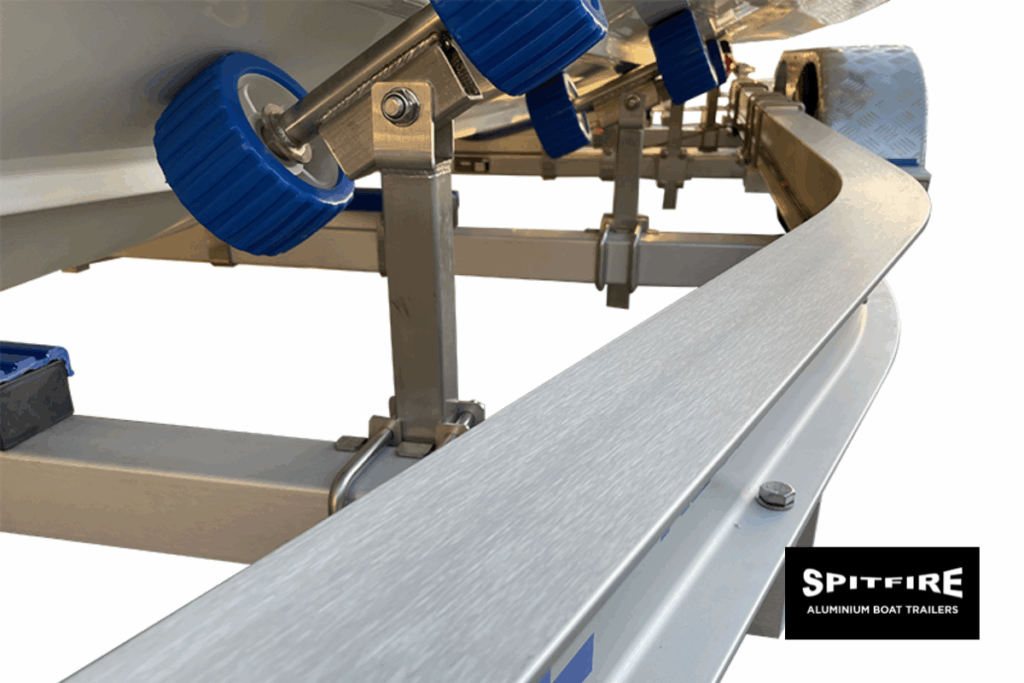
Roller-based boat trailer systems utilize strategically positioned wheels to minimize friction between the boat hull and trailer structure, creating nearly effortless launching and retrieval operations. These systems excel in situations where boat weight, ramp conditions, or operator strength limitations make traditional bunk systems challenging to use effectively.
Modern roller systems incorporate multiple contact points along the boat’s hull, distributing support while maintaining the low-friction characteristics that make them attractive for heavier vessels. Quality roller systems feature corrosion-resistant bearings, durable wheel materials, and precise positioning to ensure smooth operation over thousands of launch cycles.
Spitfire’s roller configurations utilize marine-grade components specifically selected for Australian saltwater conditions. Our rollers feature sealed bearings that resist saltwater intrusion, polyurethane wheels that won’t mark gelcoat surfaces, and stainless steel mounting hardware that maintains strength and adjustability over extended periods. These systems can be configured as primary support (full roller systems) or integrated with bunk systems for hybrid applications.
The fundamental advantage of roller systems lies in their ability to convert sliding friction into rolling friction, dramatically reducing the force required to move boats on and off trailers. This mechanical advantage becomes increasingly important as boat size and weight increase, particularly for vessels approaching the upper limits of trailer capacity.
Rollers also adapt well to varying hull shapes and sizes, making them versatile choices for boat owners who may upgrade their vessels or use the same trailer for multiple boats. The individual adjustment capability of quality roller systems allows fine-tuning of support points to match specific hull contours, ensuring optimal weight distribution and protection.
However, roller systems require more maintenance than guide systems due to their moving parts and bearing assemblies. Regular lubrication, bearing inspection, and wheel replacement become necessary maintenance items that guide systems largely avoid. Spitfire addresses these requirements through careful component selection and detailed maintenance guidelines provided with every roller-equipped trailer.

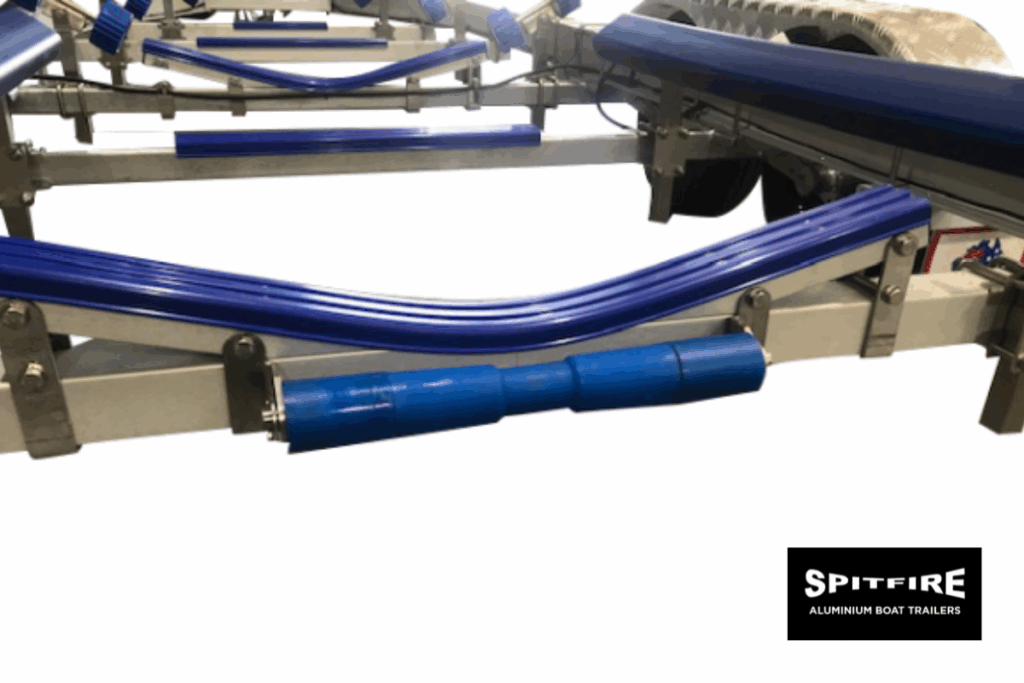
Spitfire’s VeeGuide bunk system represents decades of Australian marine engineering evolution, combining the stability and control advantages of traditional guides with innovations that address the unique challenges of Australian boating conditions. This proprietary system comes standard on all Spitfire trailers, reflecting our confidence in its superior performance across diverse applications.
The VeeGuide design incorporates multiple contact surfaces that work together to provide comprehensive boat support during transport and launching operations. Primary Vee-shaped guides handle lateral positioning and stability, while integrated HDPE keel slides support the boat’s weight and facilitate smooth launching motion. This multi-point contact system distributes loads effectively while maintaining the low-friction characteristics essential for easy operation.
Material selection for VeeGuide bunks focuses on durability in saltwater environments, with marine-grade carpeting that resists UV degradation and saltwater corrosion. The underlying structure utilizes high-strength aluminium profiles that maintain their shape under load while providing the necessary adjustability for different boat configurations. This attention to material quality ensures long-term performance with minimal maintenance requirements.
The engineering superiority of Spitfire’s VeeGuide system becomes apparent in real-world applications where boat owners face challenging conditions. The continuous support provided by the guides creates exceptional stability during highway transport, reducing boat movement that can cause fatigue and damage over long distances. This stability translates directly into better fuel economy and reduced wear on both boat and trailer components.
During launching operations, VeeGuide bunks excel in shallow water conditions common throughout Australian waterways. The extended contact area allows effective boat support even when the trailer can’t be fully submerged, enabling successful launches in minimal depth situations where roller systems might leave boats high and dry.
The self-alignment characteristics of properly designed Vee guides prove invaluable for single-handed operations, a common requirement for many Australian boat owners. The guides naturally funnel the boat into correct position during retrieval, compensating for minor alignment errors and reducing the precision required from the operator. This forgiving nature makes launching and retrieval more enjoyable and less stressful, particularly for less experienced operators.
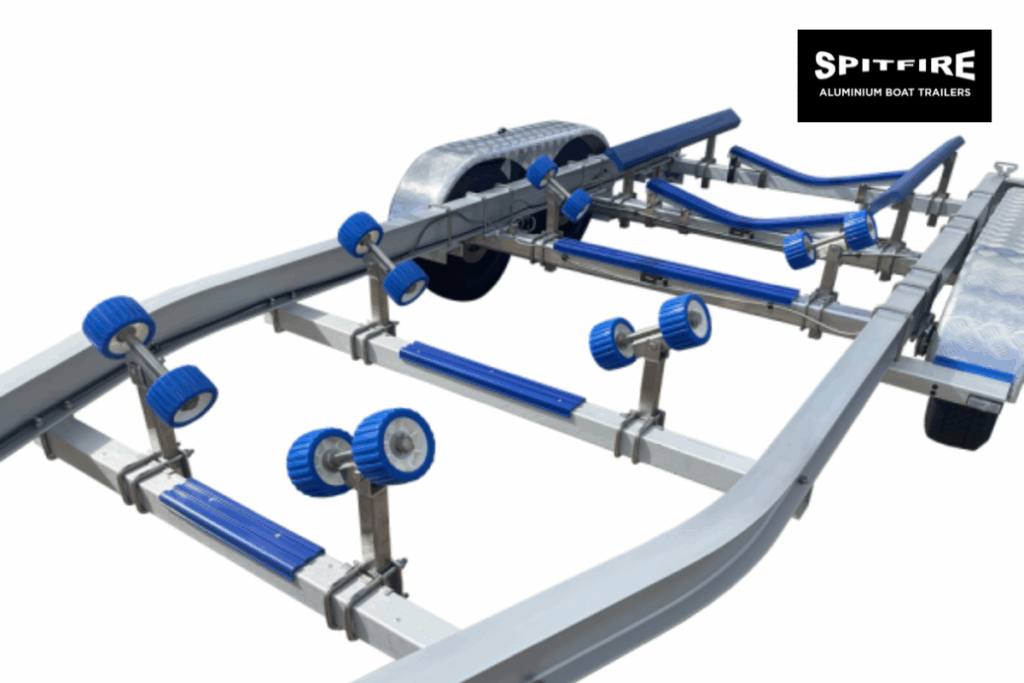
The decision between Vee guides and roller systems depends on multiple factors including boat type, size, usage patterns, and launching conditions. Understanding these variables helps ensure optimal performance and satisfaction with your trailer configuration choice. For an in-depth comparison, explore our detailed analysis of roller vs bunk trailers to understand which system best suits your specific needs.
Boat hull design significantly influences system effectiveness, with deep-V hulls generally benefiting from the centering action of Vee guides, while flatter-bottom boats may work equally well with either system. Boat weight also plays a crucial role, as heavier vessels gain more benefit from the friction reduction offered by quality roller systems, particularly when launching single-handed or on steep ramps.
Operating conditions provide another critical consideration, with shallow water launches favoring guide systems and deep water operations potentially benefiting from roller configurations. Wind and current conditions at your typical launching locations also influence system choice, as guides provide better control in adverse conditions while rollers offer easier operation in calm situations.
For boats in Spitfire’s popular 4.6m to 6.4m range, VeeGuide bunk systems typically provide the optimal balance of performance characteristics. These boats rarely exceed weights where roller systems provide significant launching advantages, while the stability and control benefits of guides prove valuable across diverse operating conditions. For detailed guidance on choosing the right boat trailer size, our comprehensive sizing guide helps match your specific vessel requirements.
The relatively light weight of boats in this category means that the friction reduction offered by rollers doesn’t provide substantial operational benefits, while the maintenance simplicity of guide systems becomes a significant advantage. Guide systems also handle the hull shape variations common in this size range more consistently than roller systems, which may require frequent adjustment as boat configurations change.
Spitfire’s standard VeeGuide configuration for these trailers incorporates all necessary features for optimal performance, including properly angled guides, HDPE keel slides, and marine-grade carpeting. This comprehensive system handles everything from shallow-draft tinnies to deep-V fishing boats with equal effectiveness, making it the logical choice for most applications in this size range.
As boat size and weight increase into Spitfire’s 6.5m to 8.5m trailer range, the decision between guides and rollers becomes more complex. Heavier boats benefit increasingly from the mechanical advantages offered by quality roller systems, particularly for operators who launch frequently or work with steep ramps where boat weight becomes a significant factor.
However, larger boats also gain more from the stability advantages offered by guide systems during highway transport. The increased windage and weight of larger vessels make the secure positioning provided by VeeGuide bunks increasingly valuable for safe, comfortable towing. This creates a situation where hybrid systems combining guides and rollers may provide optimal performance.
Spitfire’s approach to larger trailers allows customization of support systems to match specific boat and usage requirements. Our technical team can assess individual applications and recommend the optimal combination of guides, rollers, and support points to deliver superior performance for specific boat and operating condition combinations.
The maintenance requirements for Vee guide and roller systems differ substantially, with these differences becoming more significant over extended ownership periods. Understanding these requirements helps boat owners make informed decisions and budget appropriately for ongoing trailer maintenance.
Guide systems require minimal ongoing maintenance, with primary requirements focusing on cleaning, inspection, and occasional replacement of wear surfaces. The absence of moving parts eliminates the bearing maintenance, lubrication requirements, and mechanical adjustments necessary with roller systems. For comprehensive maintenance guidance, see our detailed guide on how to maintain your boat trailer. This simplicity translates into lower ongoing costs and reduced maintenance time requirements.
Roller systems demand more attention due to their mechanical complexity, with regular bearing inspection and lubrication being essential for reliable operation. Saltwater exposure accelerates wear in bearing assemblies, making frequent maintenance cycles necessary for boats operating in marine environments. However, properly maintained roller systems can provide years of reliable service when maintenance schedules are followed consistently.
Australian saltwater conditions present unique challenges for both guide and roller systems, though the impact varies significantly between system types. Saltwater exposure accelerates corrosion in metal components while promoting growth of marine organisms that can interfere with system operation.
Guide systems handle saltwater exposure relatively well due to their simple construction and material choices. Marine-grade carpeting resists saltwater damage while aluminium guide structures incorporate appropriate alloys and protective coatings. Regular freshwater rinsing and occasional deep cleaning maintain system performance with minimal effort or expense.
Roller systems face greater challenges in saltwater environments due to their bearing assemblies and moving parts. Saltwater intrusion into bearings causes rapid degradation, while marine growth can interfere with roller operation. These systems require more frequent inspection and maintenance cycles, along with higher-grade components designed specifically for marine applications.
Spitfire addresses saltwater challenges through careful component selection and protective treatments applied during manufacturing. Our VeeGuide systems incorporate materials and finishes proven in Australian marine conditions, while our roller options utilize sealed bearings and corrosion-resistant hardware specifically chosen for saltwater durability.
Shallow water launching represents one of the most challenging conditions for boat trailer systems, requiring careful consideration of system capabilities and limitations. Australian waterways often present shallow launching conditions due to tidal variations, seasonal water levels, and infrastructure limitations, making shallow water performance a critical consideration for many boat owners.
Guide systems excel in shallow water conditions due to their extended contact area and ability to support boats even when trailers cannot be fully submerged. The continuous support provided by VeeGuide bunks allows effective launching in minimal depth situations where roller systems might leave boats stranded above the waterline.
The HDPE keel slides incorporated in Spitfire’s VeeGuide systems prove particularly valuable in shallow water applications, providing low-friction support for the boat’s keel area while distributing loads effectively. This design allows boats to slide off guides smoothly even when minimal water depth prevents full trailer submersion.
Tidal variations present ongoing challenges for boat owners, with launching conditions changing dramatically throughout each tidal cycle. Guide systems adapt well to these variations due to their ability to function effectively across a wide range of submersion levels, while roller systems may become less effective as water depth decreases.
Seasonal water level changes compound these challenges, with dry seasons often reducing available depth at popular launching locations. Trailer systems that perform well in minimal depth conditions provide greater flexibility and access to more launching locations throughout varying seasonal conditions.
Spitfire’s VeeGuide technology addresses these challenges through design features that maintain effectiveness across varying water depths. The extended contact area and low-friction materials allow successful launching even when water depth is insufficient for full trailer submersion, providing boat owners with greater operational flexibility.
Modern boat trailer design increasingly incorporates customization options that allow optimization for specific applications and operating conditions. Spitfire’s engineering expertise enables custom configurations that combine the best aspects of different support systems to deliver optimal performance for individual requirements.
Hybrid systems incorporating both guides and rollers can provide the stability advantages of guide systems while incorporating the launching ease offered by strategic roller placement. These configurations prove particularly effective for larger boats where transport stability and launching ease both present significant considerations.
Custom guide configurations can address specific boat hull shapes or operational requirements through modified angles, contact points, or material selections. Spitfire’s manufacturing flexibility allows these customizations while maintaining the structural integrity and performance characteristics that define our trailer quality.
Specialized applications may require modifications to standard guide or roller configurations to achieve optimal performance. Commercial applications, specialized boat designs, or unique operational requirements can benefit from custom engineering that addresses specific challenges while maintaining overall system effectiveness.
Spitfire’s technical team works with customers to identify optimal configurations for challenging applications, drawing on decades of experience with diverse boat types and operating conditions. This consultation process ensures that custom configurations deliver superior performance while maintaining the durability and reliability expected from Spitfire trailers.
The flexibility of our manufacturing processes allows cost-effective implementation of custom configurations without compromising production quality or delivery schedules. This capability provides boat owners with access to truly optimized trailer systems that address their specific requirements while maintaining Spitfire’s quality standards.
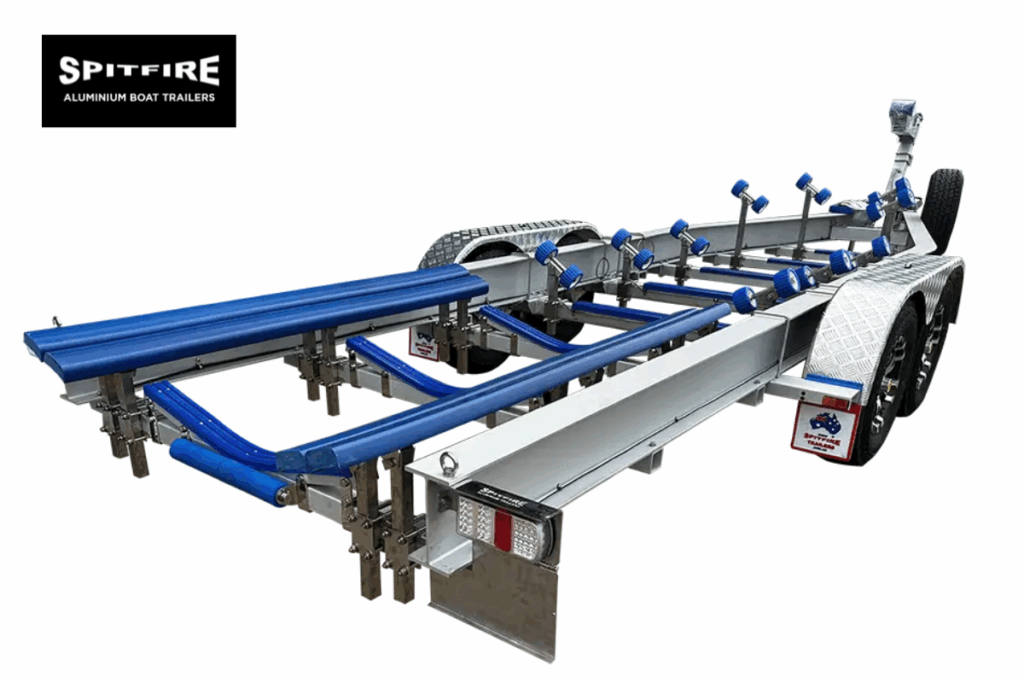
Spitfire’s VeeGuide and roller systems integrate seamlessly with our complete trailer designs, working in conjunction with hydraulic disc brakes, torsion axles, and precision engineering to deliver superior overall performance. This systems approach ensures that every component contributes to optimal trailer function rather than creating conflicting requirements or compromised performance.
The integration of guide systems with Spitfire’s low-profile trailer design creates exceptional stability during transport while maintaining easy launching characteristics. Our torsion axle systems provide smooth, controlled suspension action that protects both boat and trailer from road shock while maintaining proper guide alignment under all conditions.
Hydraulic disc brake systems work effectively with both guide and roller configurations, providing consistent, controlled stopping power that enhances safety during transport and precise control during launching operations. The combination of these systems creates trailer performance that exceeds the sum of individual component capabilities.
The systems integration approach utilized by Spitfire delivers performance advantages that cannot be achieved through individual component upgrades or modifications. Each system component is engineered to work optimally with other components, creating synergistic effects that enhance overall trailer performance.
This integration extends to manufacturing processes, with guide and roller systems installed and adjusted during production to ensure optimal alignment and performance. Factory setup eliminates the trial-and-error process often required with aftermarket modifications while ensuring that warranty coverage extends to complete system performance.
The result is trailer performance that consistently exceeds customer expectations while providing the reliability and durability required for long-term Australian marine service. This comprehensive approach reflects Spitfire’s commitment to engineering excellence and customer satisfaction across our complete product range.
Q: What’s the main difference between Vee guides and rollers on boat trailers?
A: Vee guides provide continuous hull support and exceptional boat alignment during launching, while rollers use mechanical advantage to reduce friction for effortless boat movement. Spitfire’s VeeGuide bunks come standard and offer superior control and stability.
Q: Which system works better for single-handed boat launching?
A: VeeGuide systems excel for solo operators due to their self-aligning characteristics and forgiving nature. The guides naturally center your boat during retrieval, compensating for minor alignment errors and reducing operator precision requirements.
Q: Do roller systems require more maintenance than guide systems?
A: Yes, roller systems require regular bearing lubrication and inspection due to moving parts, while guide systems need only periodic cleaning and wear surface inspection. Saltwater conditions accelerate roller maintenance requirements significantly.
Q: Can Spitfire trailers be converted between guide and roller systems?
A: Spitfire trailers can be customized with different support systems during manufacturing or modified afterward. Our technical team can assess your specific requirements and recommend optimal configurations for your boat and usage patterns.
Q: Which system performs better in shallow water conditions?
A: Guide systems, particularly Spitfire’s VeeGuide bunks with HDPE keel slides, excel in shallow water due to extended contact area allowing effective launching even when trailers cannot be fully submerged.
Q: Are there weight limitations for different support systems?
A: Both systems handle Spitfire’s complete weight range up to 4500kg ATM effectively, though heavier boats may benefit more from roller systems’ friction reduction. VeeGuide systems provide superior transport stability regardless of boat weight.
Q: How do saltwater conditions affect guide and roller systems?
A: Guide systems handle saltwater better due to simpler construction and marine-grade materials. Roller systems require more frequent maintenance in saltwater due to bearing assemblies and moving parts vulnerable to corrosion.
Q: Can hybrid systems combine guides and rollers effectively?
A: Yes, hybrid configurations can provide transport stability from guides while incorporating strategic roller placement for launching ease. Spitfire can engineer custom hybrid systems for specific applications requiring both characteristics.
Q: What maintenance schedule is recommended for each system type?
A: Guide systems need thorough cleaning after saltwater use and periodic wear inspection. Roller systems require monthly bearing checks, quarterly lubrication, and annual bearing replacement in heavy saltwater use conditions. Consult our maintenance best practices guide for detailed procedures.
Q: How does boat hull shape influence system choice?
A: Deep-V hulls benefit from guide systems’ centering action, while flatter hulls work well with either system. Spitfire’s VeeGuide bunks accommodate most Australian boat hull designs effectively through proper angle engineering and adjustability.
Ready to experience the superior performance of Spitfire’s VeeGuide bunk technology or explore our roller options? Use our Boat Sizing Guide to find the perfect trailer configuration for your vessel, or visit our Townsville, Brisbane, or Rockhampton showrooms to see these systems in action and discuss your specific requirements with our expert team.
|
Uploaded
Failed
|
 |